Showing posts with label strawberries. Show all posts

Monday, June 17, 2013

Fragaria (Strawberry) Stolons (Runners)


For folks who know little about plant propagation or the way some plants reproduce, here is one way strawberries can produce mini plantlets that are clones from the parent plant.


Off to its side is a baby strawberry plant which has started to situate itself  about 8 inches away from the original plant.

Long tendril like stems called stolons emerge from the base of the parent plant and meander over the surface of the soil (or rocks) looking for a place to grow on its own. First by starting to produce a leaf at a joint, a fair enough distance from the parent plant.

Remove any smaller babies and long stolon stems. They will just take energy away from the plant you want to establish.

If you look carefully at this joint (node) you'll see tiny roots pointing downward to the soil surface. This is the start of a whole new plant - attached by an "umbilical" cord of sorts.

There are two ways you can establish the new plant. 1) Just allowing the plant to find its own way and rooting itself, leaving it until next season.

Or...

2) Cutting it from the parent plant right now, once more than one leaf is present and planting it in an ideal location for the rest of its life. If you want to advance the growing, plant it into a container for a couple of weeks to get a better root mass before planting it out in the garden.


Here, I just situated the baby plant in a location free of competition; it has good light and ample space to flourish.


You can even grow strawberries in containers and let the stolons droop over the container, making a hanging basket. Unfortunately, the stolon plants won't produce any strawberries this season.

Perhaps you are familiar with the common house plant called: Spider Plant Chlorophytum comosum.  This same principal can be applied to this plant as well. Their stolons are just the same as the strawberry.

NOTE: Two aspects of stolons that are negative: 1) they do remove essential energy from the parent plant; 2) you get plants establishing everywhere.

When you see stolons and flowers on the strawberry plant, much of the plant's energy will go to the stolon and not the fruit if they are left to themselves. If you've ever gone strawberry picking as I have, you'll notice many of the strawberry plants have had their stolons removed for this purpose. Nothing is better than having sweet, juicy strawberries. Keep some of the stolons for next year's crop, but do remove the rest of them throughout the harvest season.


Saturday, March 17, 2012

Life Is Emerging

Blue and White Scilla
The unusual warm weather has put a spring in everyone's step. People are outside, walking, running and enjoying this early gift of spring. It's been really lovely out. However, I can't help but be concerned for fluctuating temps that may come down the pike. Let's hope April's weather is not overly severe. I would hate to see fruit trees bud and a harsh frost kill off tender blooms and other budding shoots.

I planted several bulbs last fall. And I am thrilled, as my neighbours warned me about squirrels digging up all theirs over the years. Most of them are popping up!  I am just not used to the litter layer of leaves and debris I've left. I can see their beneficial use. The earth is quite loose and not compacted from the rain!

In sunnier areas around my neighbourhood I've seen Narcissus (Daffodils) and Crocus already in bloom. It's sooo early! My shadier spot out back is coming along though.

Narcissus " Jetfire Tops "
I figured, the smaller the garden, the smaller the bulb would do the trick. Scilla, Muscari, Species
( "Chrysantha" ) Tulips, and dwarf Narcissus " Jetfire Tops " varieties are mainly multiplying bulbs. Smaller flowers and dwarfer habit, but they increase in number over the years. They won't take too much time to bloom and their foliage won't need to be removed, leaving my perennials to grow in and around them.

I planted them in 3's only because I hope they will multiply in larger batches next season.

Chives


Soon I will be able to cut back and use my chives again. Yay!


Oregano


One bonus of the mild winter is my oregano overwintered and...


Chrysanthemum


 ...my Chrysanthemum.

Here in the greater Toronto Area, it's a hit and miss generally to overwinter Chrysanthemums. So I am grateful.

Strawberry "All Star"


My strawberries have flushed leaves and look twice a large as last year.

Sedum telephium " Autumn Joy "


I was late bringing out some overwintered perennial Sedum "Autumn Joy" from the garage where I stored them. Last October I uprooted and divided them, transplanting into pots too late in the season to get them planted in time for overwintering. I have a garden I tend to and will be planting them there hopefully in a few weeks. Within 3 days of this warm trend, they grew all this pale new growth. I am always so amazed at plants and their will to grow, even in the darkest spots. I'm going to prune them back hard later, I just brought them out to colour up a bit before I do it. I'm just amazed!


Finally I see my roses have started to flush as well.

El Nino, warming trend - whatever it is, I"m going to keep my ear tuned to the weather reports in case winter hits one last blow. Let's hope not.

Saturday, February 25, 2012

Companion Planting - Vegetable Garden Planning

Companion planting is not complicated. It is so beneficial and should be a part of your vegetable garden planning.

When you group a lot of veggies and segregate them from other plants in your garden, you'll wind up making them an easy target for pests and you may deplete the soil if you replant the same vegetation year after year in the same place.  Planting them in smaller groups, among other companion plants, will introduce a whole variety of beneficial insects and or plant life that aid the growth of your veggies.

  • Some plants fixate nitrogen in the soil - legumes and certain clovers do that well.
  • Some exude chemicals from their root system that keep bugs away - Marigolds and Chrysanthemums are ideal.
  • Some repeat in bloom all summer, which bring bees and other pollinators to the garden.

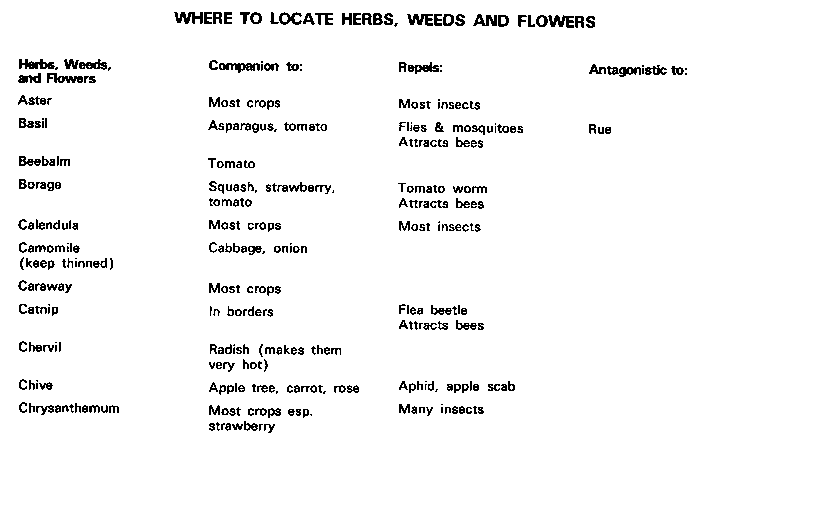
Here are great resource lists of companion, and incompatible plants you should know about.

It works for berries too

In the past, I've used these plants together with success:
  • Nasturtium - with radish or lettuce
  • Marigolds - with herbs
  • Garlic or Campanula persicifolia - with roses
  • Borage - with spinach, lettuce, cabbage
  • Beebalm (Monarda) - with tomatoes
  • Chrysanthemum - with strawberries

Now that my garden is so small, I have limited space to plant all sorts of companion plants. However, I am planting my veggies in with perennials and shrubs and I noticed the benefit last year and will do it again.
Related Posts Plugin for WordPress, Blogger...