Thursday, November 10, 2016

Plant Profile: Gladiolus callianthus - Abyssinian Sword Lily, Peacock Orchid

One of the reasons I love walking is seeing other gardens along the journey.

I happened along these flowers last week and unlike the common gladiola, these peaked my interest.


The gentleman raking the leaves allowed me to photograph the flowers after I stood there and examined them for a while. He mentioned they were fragrant. And quite so! I wanted to ask him more questions, but he went out back and with my phone I snapped the following.


Gladiolus callianthus (murielae). Zone hardy to 7b.


It's a member of the gladioli family, originating from East Africa. Their bulbs (corms) are to be planted in spring. Not winter hardy in Ontario, you must remove them before the onset of heavy frosts.


Given this is the warmest November I can recall, they continue to bloom and give interest to the garden, when most everything is slowly retiring for the winter.

Great choice for the sunny spot in the garden. Not many fragrant flowers are around this time of year. A real treat for walk-by enjoyment.

Wednesday, November 02, 2016

Rust on Roses - Phragmidium tuberculatum

Now that it's November, leaves are dropping everywhere.  Yet, this David Austin Rose  doesn't seem to want to let them go!


Notice anything wrong with the leaves?


Those brown/reddish speckles are not normal.


Turning this set of leaves around, do you see the little orange bumps?

This is called Rose Rust (caused by a parasitic fungus called: Phragmidium tuberculatum). Very common, among numerous rose cultivars, especially older hybrids. Some roses are far more susceptible to it than others.


Given the rose will eventually drop its leaves anyway - I removed every one from the rose and they will go in the garbage. This form of rust persists until the leaves drop and if I don't remove them from the site, the probability is higher for the rust to return next year. The best is to destroy or toss in the bin.


I've seen rust so bad on roses, that large lesions can be seen on the stems as well. Thankfully, in this circumstance, I didn't notice any.

Usually I give the roses a hard cut back in the spring, but in this case, I hit it back hard to promote air circulation over winter and come spring. Poor air circulation is one of the main causes of rust developing.

Rust can weaken the plant, diminishing flower bud development. What's a rose without its bloom?

There are fungicides on the market, but I rather use this preventative method, in hopes it will not return next year.


The black pimples, or pustules are the ones that over winter for next year.  The photo above shows how the orange bumps begin to darken to black. This is why you must remove the leaves.

Leaf removal can be done in the summer too, as many roses will respond by re-foliating.

Well worth the effort.


Wednesday, October 26, 2016

Evergreen Hedges - Gone Wrong

Manicured, healthy hedges that are done right, add valuable structure to the garden. They help lead you along the garden path, or keep you out - depending on their purpose.

I want this post to be about what could of been done to achieve the desired look intended.

I witnessed the installation of this hedge - this past July. Everything in me wanted to go out and speak to the workers and owners of the home, but it wasn't my place and now I feel bad.


Ways this went wrong:

1)  Planting time: wrong month and what was the driest summer the GTA has seen in a long time. Hedges like this should be planted in late May and or mid-late September. Spring and early fall planting gives the plants a chance to acclimate to their new situation; when cooler temperatures allow developing roots to grow. Strong root development would give the evergreens more stamina in the heat of the summer.

2) Distance from the sidewalk: this is where most folks go wrong. I get you want to have a perimeter border to your property, but two major factors need to be considered first:
  • Municipal sidewalks are not your own: City of Toronto maintains them and provides winter maintenance and the occasional removal and repair of concrete. Since these yews were still young in stature, their mature size would eventually hug the sidewalk edge and you can't prevent outsiders from damaging the evergreens when they perform maintenance. Salt damage, the occasional "whoopsie" - you know, when the slice of a plough blade scrapes into your turf.  Not to mention any infrastructure they need to access below can easily cause hedges to be damaged. You need to think long term when designing a hedge location.
  • Foot traffic and dog urine. Enough said.
3) Not considering mature sizing when selecting their location. Depending on the evergreens chosen, certain cultivars require more pruning then others. To have nice thick hedges in the GTA, I'd recommend you allow at least 18-20" breadth of growth to help sustain its health. The aim is trimming the hedge nicely into shape as it fills in. These yews, I'm afraid, are too close to the walkway and will require more heavy shearing to maintain shape. You need to keep the foliage and branches away from foot traffic.

4) Position relative to sun/wind exposure.  This house faces North, placing the sidewalk on the north/west facing exposure. Sun refracts heat off of the concrete, not to mention the roadway, which has no boulevard grass to buffer the sun's rays or salt spray from salter trucks.

5)  Soil prep is key before planting. A trench should be dug twice as wide as the container and the soil should be thoroughly amended with amazing soil, mixed with existing soil prior to installation. A great top dressing of composted mulch would be a total bonus. 


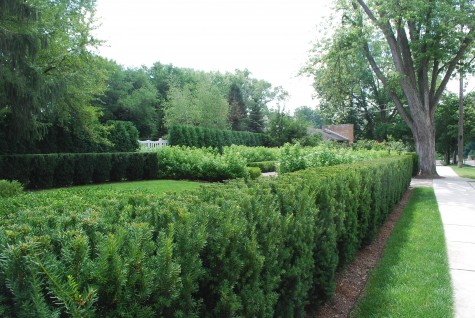
Here is an example of how a hedge along a walkway can be done successfully...

Photo courtesy of Dirt Simple: 


Great hedging lines are enhanced with a buffer zone of mulched earth and a 2 foot turf boarder in front of the Yews. This will help keep foot traffic and municipal "paws-off", and prevent any possible removal or damage by others.

Well done, Dirt Simple!

Friday, October 07, 2016

Red Banded Leaf Hopper - Graphocephala coccinea

It's the beginning of October and as we start to prep for autumn clean up, I noticed our David Austin Rose has set a bunch of new buds and on closer inspection, I noticed these beauties.


Wow. I've seen dozens of leaf hoppers before, but this Red Banded Leaf Hopper (Graphocephala coccinea) is beautiful! I tried taking several cell phone photos, but at this size I couldn't capture their intense colour properly.


Leaf hoppers are sap sucking insects, and as they feed you'll see honeydew droplets excrete from their rear ends. If numbers were greater than the 5-6 that I saw on the rose, I would relocate them. Too many and they would suppress the sap from reaching the buds.


Completely yellow beneath, they can hop quite a distance from plant to plant anyways. I let them drink and do their thing. Incredible colour display, eh?


Nature is so beautiful.

Related Posts Plugin for WordPress, Blogger...