Sunday, May 14, 2017

Pet Peeve - Mulched Trees (aka the Coned Volcano)

So many new trees are going to be planted in the next few weeks.  I wonder how many will be mulched like this disaster:


This may be a harsh opinion, but it's warranted. Not only has the tree been planted too "proud" (meaning not level to the soil), but not only do we have the "cone" flared up mound, but we have red dyed mulch. Notice something else?  The plastic tree guard at the base of the tree is also nearly buried.

What happens to the tree trunk when mulch covers the bark?  Think about this comparison. What happens to your finger when you wear a bandaid wrapped around?  Your skin becomes soft, wrinkled and sometimes when you wear it a long time, the skin peels - right?  Well, the same thing happens to bark. Moisture, insects and possible mould will perpetually be in contact with the young bark tissue and possible suckers may develop.  Not what you need to establish a young tree.


Years later, the tree will continue to need mulch to cover this mound, like in the photos below.


To me the roots and the base of the tree would better be suited at grade - so that water can pool and collect during the heat of the odd summer shower. Snow melts quicker on these cone mounds.  Also the suns rays will bake the soil beneath quicker. Needless stresses; if only a proper planting and placement of mulch was achieved from the onset.

Below are better samples of tree plantings.

Here's why:


  • Using natural shredded bark mulch knits together. It suppresses weeds and keeps the roots cool - protecting them from the elements
  • Creating a crater in the middle ensures mulch doesn't touch the bark of the young tree


The mulch is spread to the width of the canopy of the newly planted tree. Granted, the tree will grow wider and thus the high edges (surplus) can be raked further out when the tree starts to branch out further. This is called the drip-line.


  • The crater not only helps keep the mulch away from the trunk, but when you fill a water bladder (the green bag) it helps to stabilize it. This is fantastic. If you are watering a tree on your own property, you can localize the water in the crater without it running off.
  • A lawn mower or string trimmer is unlikely to cause tree trunk damage when the tree is mulched well.


Here is a diagram resource as to how we are to mulch trees:
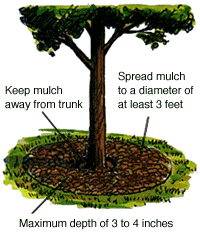
Diagram by: Arbor Day Foundation
Another resource:

Diagram by: Harvest Power
With all the info available, I still can't understand why mulching is still done in the volcano-cone style.

Please be aware,


Sunday, April 30, 2017

Toronto's High Park - Native Plant Sale: May 7th, 2017

If you live in the Toronto area and would like to know more about and to buy native plants  - please visit High Park's Native Plant Sale. Sunday May 7th, 2017


Here's their info and website:

High Park Stewards Native Plant Sale

Sale Location: In front of the High Park Greenhouses. (Plants for sale are subject to availability.) For more information go to www.highparknature.org or
email stewards@highparknature.org.  


"The plants in this sale are grown in the High Park greenhouses by volunteers as part of the High Park Stewards program. They are sold to encourage the use of native plants in home gardens and are perennial, except where noted. You can learn about the plants in the rare black oak ecosystem in High Park, and help restore its ecosystem by joining High Park Stewards events. This list is subject to plant availability."
 
What's available:

Plants for sun, shade, wet conditions....you name it!
Link ---> http://www.highparknature.org/wiki/uploads/Resources/plant_sale_brochure_2017.pdf


Where:


Some restrictions: " For fairness, the maximum number of plants available per person before 1:00 pm is restricted to small orders. After 1:00 pm, larger orders can be filled, depending on the number of plants available. " 

Sign up to volunteer!

Help our gardens and pollinators flourish! Please go!


Sunday, April 23, 2017

Heidi, What's Wrong with my Hinoki Cypress? It's going brown!

Growing Hinoki Cypress (Chamaecyparis obtusa nana) in Southern Ontario can be a challenge at times, considering we get whopper winters occasionally. So when I was asked this question - I was hesitant to think winter damage.

From far, yeah, the cypress was quite brown. Don't jump to conclusions, but rather take a closer look.


No browning was coming from the inside of the plant, but instead on its tips.


These are in fact pollen cones.

Conifers fall under a classification known as Gymnosperms. They don't have flowers like other classifications (Angiosperms). They instead bear cones within their scale leaves which later develop seed for reproduction.

What you are seeing, are swelling cones borne at the tips of the scale foliage of the cypress. They will age brown but for now are almost reddish pink.


I will update in a week or so, when the pollen is ready to be released.

Not to worry, this plant is happy and ready to reproduce - bearing seed cones later in the summer.

It's a good time to mulch beneath the plant and water if rains are infrequent. Overall - a happy plant. Nothing wrong. Just the plant doing its thing...

Saturday, April 08, 2017

Rose Mildew - Podosphaera pannosa (on Rosa glauca)

I'm sure I'm not the only one who is concerned about Southern Ontario winters and spring thaws.  We never seem to get a slow warm up in spring anymore. Instead, there's constant fluctuations; +10˚C one day, -8˚C the next.

One of the results of these fluctuations, is mould and fungus development on many plants.


I just walked through the gate and noticed something on our hardiest of roses. 


Do you notice it?

Rosa glauca is one of the main pollinator plants we use to attract insects and birds to the garden. 


Rosa glauca's simple, single flowers attract so many pollinators. It's so lovely to watch and the flowers say nothing but hello and bring vibrance to a dark corner.


Great silver/blue foliage allow the orange-red hips to jump out in contrast. Birds love these hips.


Incredibly tough and hardy, there aren't too many disease issues with this rose at all.

I've never dealt with mildew on this rose before, but as I bent down the stems to see the powdery white mass that I spotted way above my head, it revealed more on the other side.


In fact, I found about 6 younger stems with this white furry coating.


I pruned it back to about 12" below the coated area to avoid any mildew from coming in contact with other stems or the stem it was cut from.  Be thorough with removal and try not to dislodge any mildew or let it come in contact with any remaining stems.


Do not compost these stems. Burn or put them out for yard waste pick up. This stem (above) was sitting in our yard-waste pile a day after pruning and you'll see the mildew age to a light brown/mocha colour.  I tucked it down into the bin, so that no spores would become air-born and invade other plants near by.


As I examined the stems closely, the mildew spores invade the breathing holes called lenticels of the stem. Eventually spreading into a cottony mass. If left, the mildew would reach the buds and cause the leaves to be coated as well as the flower buds. Eventually stunting the plant, making it lose vigour and possible flowering ability.

Once leaves start to emerge, I will examine the rose more thoroughly to see any overlapping branches or growth that requires thinning out - which helps to promote more air circulation and a better tidied appearance. This is rose we generally allow to ramble and become large. I rather hate pruning it needlessly.

Heavy sigh...

At least finding it now has been one great preventative - so that we can enjoy a healthy plant this upcoming summer.


Related Posts Plugin for WordPress, Blogger...